
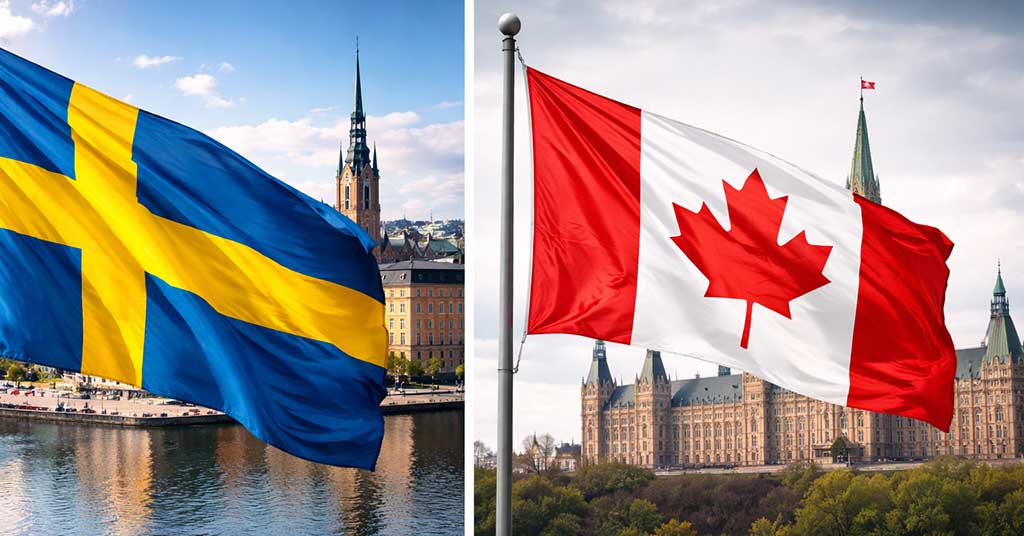
Sweden responded to public disorder with a policy change. Canada responds with political paralysis
Prime Minister Mark Carney told Davos last week that middle powers must strengthen their sovereignty in an era of great-power competition. He’s right about the diagnosis. But sovereignty isn’t built through trade diversification alone. It’s built on the unity of a people who trust their institutions to work.
Sweden understood this. Canada hasn’t learned.
Over the past decade, Sweden undertook one of the most consequential policy reversals in the western world. Once celebrated as a moral exemplar of openness, it moved deliberately toward tighter immigration controls, stricter citizenship requirements, and integration policies that place social cohesion above ideological fashion.
Sweden didn’t change course because restraint became trendy. It pivoted because conditions became intolerable.
By 2022, Sweden recorded its bloodiest year of gun violence in modern times: 391 shootings, 63 dead. Bombings doubled between 2023 and 2024, reaching 317 incidents. Police identified 65 “vulnerable areas” where parallel authority structures exercise their own form of justice. In the worst zones, officers report conditions making it “difficult or almost impossible” to fulfill their mission.
The response was comprehensive. Following Sweden’s 2022 election, the new governing coalition adopted the Tidö Agreement, which contained over 200 legislative and policy reform proposals on immigration, citizenship, and law enforcement, as its policy framework. Refugee quotas dropped from 5,000 annually to 900. Citizenship residency requirements were extended from five to eight years. New standards require language proficiency, civic knowledge, and an “honourable lifestyle” demonstrating integration before naturalization.
This wasn’t xenophobia. It was governance. Sweden’s Social Democrats, architects of the earlier open-door policy, now advocate similar restrictions. The consensus shifted because evidence demanded it.
Canada exhibits similar underlying conditions but lacks the courage to act.
Crime severity has risen since 2015. The opioid crisis has killed over 53,000 Canadians since 2016. Organized crime operates through fentanyl trafficking, auto theft rings exporting vehicles overseas, and money laundering through real estate. This criminal economy is less spectacular than Swedish gang warfare but equally corrosive.
Housing affordability has collapsed. CMHC estimates Canada needs 430,000 to 480,000 new units annually for a decade just to restore 2019 affordability, roughly double current construction rates. Health care systems strain under growing demand. Schools struggle with overcrowding and integration challenges.
Immigration acts as a stress multiplier. Population growth has outpaced the capacity of housing, health care, transit, and education. The problem isn’t newcomers themselves. It’s intake that exceeds integration capacity while enforcement wanes.
Yet Canada remains paralyzed.
Electoral incentives favour symbolism over reform. Immigration policy is tied to coalition management in urban Central Canada, where restrictive measures carry political risk. A publicly subsidized press reinforces existing policy narratives. Evidence of failure becomes miscommunication rather than misdesign. Housing shortages become funding debates. Crime becomes an optics problem.
The costs fall asymmetrically. The benefits of high immigration accrue to metropolitan labour markets and to asset owners. Costs fall on municipalities, renters, younger Canadians, and strained services with limited fiscal autonomy. This asymmetry reduces urgency among those with power to act.
Sweden’s reforms demonstrate that meaningful change isn’t anti-immigrant; it’s pro-citizen and pro-integration. A system that enforces rules, sets clear thresholds, and aligns intake with capacity is fairer to newcomers and existing residents alike. It offers membership rather than ambiguity.
Carney wants Canadian sovereignty strengthened against external pressures. But sovereignty requires internal cohesion first. A country whose citizens experience disorder while being told their concerns are illegitimate cannot project strength abroad. A country that confuses moral posture with policy cannot command respect.
Sweden chose boundaries for multiculturalism before its institutions failed. Canada theoretically retains that option. But it requires honesty about trade-offs, acceptance of limits, and the courage to tell citizens the truth.
There’s room for Canada’s established immigrant communities to lead this conversation, advocating for the integration standards and enforcement that served them, and for timid elites to defend them.
The question isn’t whether Canada needs reform. It’s whether we choose reform deliberately or accept worse policies later under worse conditions.
Sovereignty begins at home. Sweden understands that. Will we?
Marco Navarro-Genie is vice-president of research at the Frontier Centre for Public Policy and co-author, with Barry Cooper, of Canada’s COVID: The Story of a Pandemic Moral Panic (2023).
Explore more on Immigration, Public safety, Citizenship, Multiculturalism, National security, Carney government
The views, opinions, and positions expressed by our columnists and contributors are solely their own and do not necessarily reflect those of our publication.
Troy Media empowers Canadian community news outlets by providing independent, insightful analysis and commentary. Our mission is to support local media in helping Canadians stay informed and engaged by delivering reliable content that strengthens community connections and deepens understanding across the country.

