
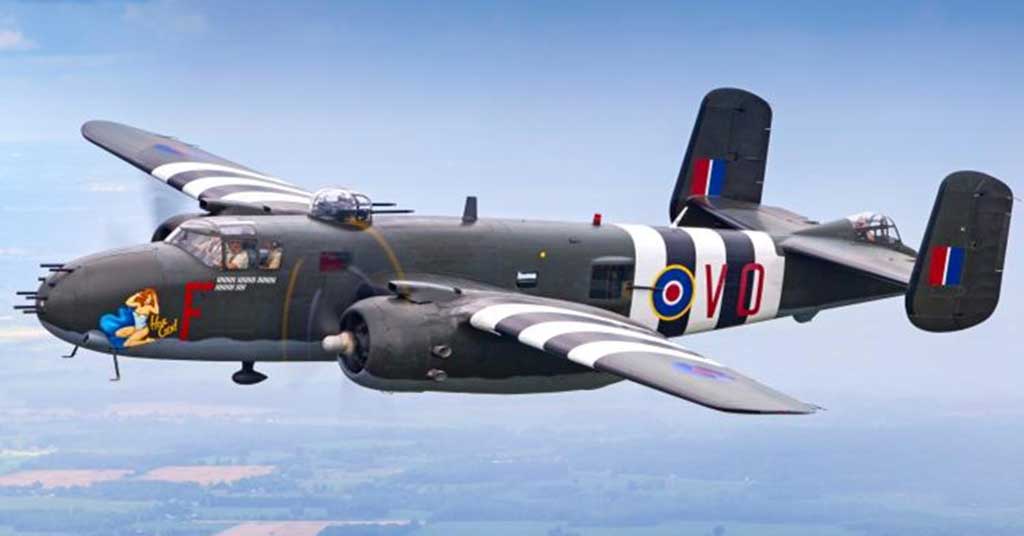
Sitting inside a B-25 showed me why Remembrance Day isn’t something we can take lightly
Here I was, sitting in the rear gun turret of our Mitchell B-25 bomber, with all my senses on guard and my head on a swivel. The day was clear, the sky could not be bluer, and the danger of enemy fighters coming at us with the sun at their back was almost a certainty.
Luckily, we had just finished our bombing run and were on our way back to base. Our experienced pilot, Major David Rohrer, co-pilot Liam Pearson, and flight engineer Jessica Side had managed to get us to the target unscathed, and we now only had to cross the water to make it home.
Suddenly, Dave had to take evasive action, jerking the plane up and to the right in an almost barrel roll. Cool as cucumbers, the rest of the crew stayed silent as they hung on while I continued to marvel at the incredible manoeuvrability of the B-25.
With 18 machine guns and a full bomb load, the B-25 was a true workhorse. Built in 1945 in Missouri, it showed just how multi-purpose the aircraft could be.
All of this was taking place in Canada last July in the country’s only airworthy B-25 Mitchell, flown out of the Canadian Warplane Heritage Museum in Hamilton, Ontario. The pilot was the museum’s CEO and the crew were volunteers. The target was Niagara Falls, then downtown Toronto (where we flew virtually at the same height as the CN Tower) and the body of water was Lake Ontario..
The experience showed the aircraft’s capabilities, but more importantly, it revealed the challenges faced by Canadian and Allied crews in the Second World War. They worked in noisy, cramped spaces that were too hot in summer and too cold in winter; faced constant danger from enemy aircraft and ground-based flak; dodged fighters and often returned with planes full of holes; flew mission after mission with little rest; and lived with the burden of seeing friends shot down or wounded.
This is what our forefathers went through. This is why we still remember and why we need to continue to honour the generations that came before and who fought for Canada and for our values. The Royal Canadian Air Force was born in 1924, 101 years ago. Its members fought gallantly alongside the Royal Air Force (RAF) and United States Army Air Forces, and many Canadians also flew in RAF and other Commonwealth units.
We owe them a debt that cannot be repaid. All we can do is make sure future generations will remember them, honour them, and stand ready to take their place in the next conflict.
Freedom is not free. It is paid for by the blood of men and women warriors prepared to pick up the torch. Warriors who have no cause except that of freedom, equality, and the protection of all.
As U.S. Army general Douglas MacArthur, who led Allied forces in the Pacific during the Second World War, said, “The soldier above all others prays for peace, for it is the soldier who must suffer and bear the deepest wounds and scars of war.”
This Remembrance Day, and at other times, let us remember and thank those who suffered wounds and scars, but let us also rededicate ourselves to follow their brave example.
Michel Maisonneuve is a retired lieutenant-general who served Canada for 45 years. He is a senior fellow at the Frontier Centre for Public Policy and author of In Defence of Canada: Reflections of a Patriot (2024).
Explore more on Remembrance Day, Second World War, Military, War/Conflict, Canadian history, Patriotism
The views, opinions, and positions expressed by our columnists and contributors are solely their own and do not necessarily reflect those of our publication.
Troy Media empowers Canadian community news outlets by providing independent, insightful analysis and commentary. Our mission is to support local media in helping Canadians stay informed and engaged by delivering reliable content that strengthens community connections and deepens understanding across the country.

