
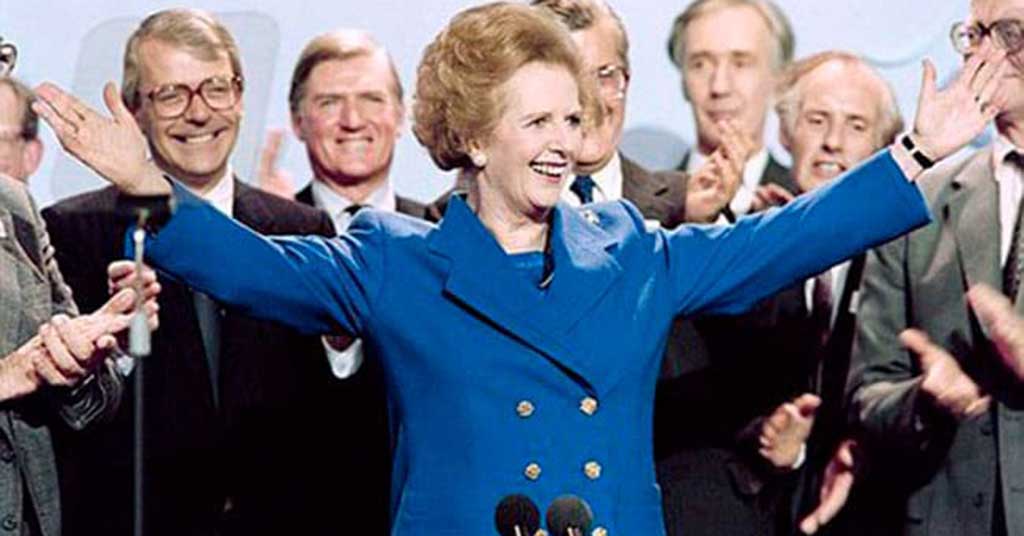
Thatcher rejected modern feminist labels but shattered the glass ceiling anyway
Title: The Incidental Feminist
Author: Tina Gaudoin
Publisher: Swift Press
Publication Year: 2025
(Available from Amazon)

There have been plenty of books about Margaret Thatcher, most notably Charles Moore’s three-volume biography. Now along comes Tina Gaudoin with The Incidental Feminist, in which she proposes to analyze Thatcher as “woman first and politician second.”
Gaudoin sets out her stall early, characterizing her subject as a paradox. One example: Thatcher’s strict Methodist upbringing and the social attitudes of the world into which she was born didn’t prevent her from having “a curiously liberal approach to sex.” Other people’s sexual proclivities weren’t an issue for her.
Here are some themes that caught my eye.
Love of fashion
If you think of Thatcher as “frumpy,” you need to think again. Her youthful correspondence with an older sister, who’d moved away, indicated a fascination with Hollywood and glamour.
Although their Grantham hometown was very much in the wartime line of fire, Thatcher’s letters didn’t focus on bombing raids and such, but rather on the films playing at the local cinema and her efforts to procure fashionable items of clothing.
As prime minister, she struck up a relationship with design doyenne Margaret King, an association cemented by the success of the chic wardrobe they put together for Thatcher’s successful visit to the Soviet Union in the early spring of 1987. And when stress threatened to overwhelm the prime minister towards the end of her time in office, King became a safety valve. A discreet phone call from 10 Downing Street would generate a “spontaneous” King visit to talk about fashion, and Thatcher would be duly calmed and distracted.
To quote King: “Fashion always fortified her. It focused her. She loved it.”
Neurodivergence
Meant to describe people whose brains are wired differently from the norm, neurodivergence is a term that’s entered the popular lexicon in recent years. Gaudoin speculates that it applied to Thatcher, citing traits associated with autism, such as rigidity of thinking, lack of a sense of humour, social awkwardness, literal-mindedness, and difficulty sleeping.
But she also relates an anecdote which complicates the view that Thatcher was essentially devoid of empathy.
In August 1989, Thatcher and her private secretary, Caroline Slocock, made an informal visit to an AIDS hospice in London’s East End. There, Slocock was amazed at Thatcher’s almost motherly kindness and attention to two terminal patients. But when Slocock subsequently learned that one of the patients had died alone, she informed the prime minister and got no reaction. Later, though, it emerged that Thatcher had sent a handwritten note and a personal cheque for 1,000 pounds to the hospital.
Some will suggest that this was just an example of “masking,” where people without empathy deliberately put on a show. Maybe. But bear in mind that the episode was private, not a photo-op. If Thatcher was “masking,” who was she “masking” for?
Ambivalence about social class
Thatcher was conflicted about class. While she was drawn to “posh” people, she was also acutely aware of the fact that she didn’t fit in. And to complicate things, there was the question of how she viewed the world.
Gaudoin puts it this way: “She spent the early part of her political career as a member of the lower middle class, trying to assimilate into a party which revered upper-class values, only then to set about destroying those upper-class boundaries and values in an attempt to create a property-owning, meritocratic democracy.”
This class-related split also manifested itself in how other people saw her. Those who’d grown up with her in Grantham viewed her success in positive terms. However, her Oxford contemporaries begged to differ.
To be sure, some of the Oxford hostility had to do with aversion to her policies. But not all. As Mary (later Baroness) Warnock told an interviewer, Thatcher “epitomised the worst of the lower middle class,” projecting “an odious suburban gentility.”
Incidental feminist?
Thatcher certainly wasn’t a feminist in the female-focused way the term has become understood. But what if the concept of feminism is broadened to include a woman breaking the glass ceiling strictly on her own merits and setting an example for others?
Thatcher’s political rise wasn’t facilitated by concepts of inclusiveness, DEI, or any of the other ideas that have gained currency in more recent times. She didn’t get ahead because she was a woman. It would be more accurate to say that she succeeded despite being a woman. Female MPs were an oddity when she first entered Parliament in 1959, and the idea of a woman becoming prime minister was considered farfetched.
Without a doubt, Thatcher’s success was an inspiration for women of varied backgrounds.
When the current U.K. Conservative leader, Kemi Badenoch, was growing up in Nigeria as a Yoruba schoolgirl called Olukemi Olufunto Adegoke, Thatcher was her role model for defying the strictures of a deeply patriarchal society. Sanae Takaichi, Japan’s first female prime minister, has also cited Thatcher as her inspiration. Even the current Labour Chancellor, Rachel Reeves, has acknowledged Thatcher’s influence in changing traditional perceptions about women and power.
Obviously, there are different ways to be a feminist.
Our Verdict: ★★★★☆
Highly recommended for readers interested in politics, leadership and biography, Tina Gaudoin’s The Incidental Feminist offers a thoughtful re-examination of Margaret Thatcher that challenges modern assumptions about feminism, class and political authority.
Troy Media columnist Pat Murphy casts a history buff’s eye at the goings-on in our world. Never cynical – well, perhaps a little bit.
Explore more on Feminism, Biography, Non-fiction, Politics in Books
The views, opinions, and positions expressed by our columnists and contributors are solely their own and do not necessarily reflect those of our publication.
Troy Media empowers Canadian community news outlets by providing independent, insightful analysis and commentary. Our mission is to support local media in helping Canadians stay informed and engaged by delivering reliable content that strengthens community connections and deepens understanding across the country.

