
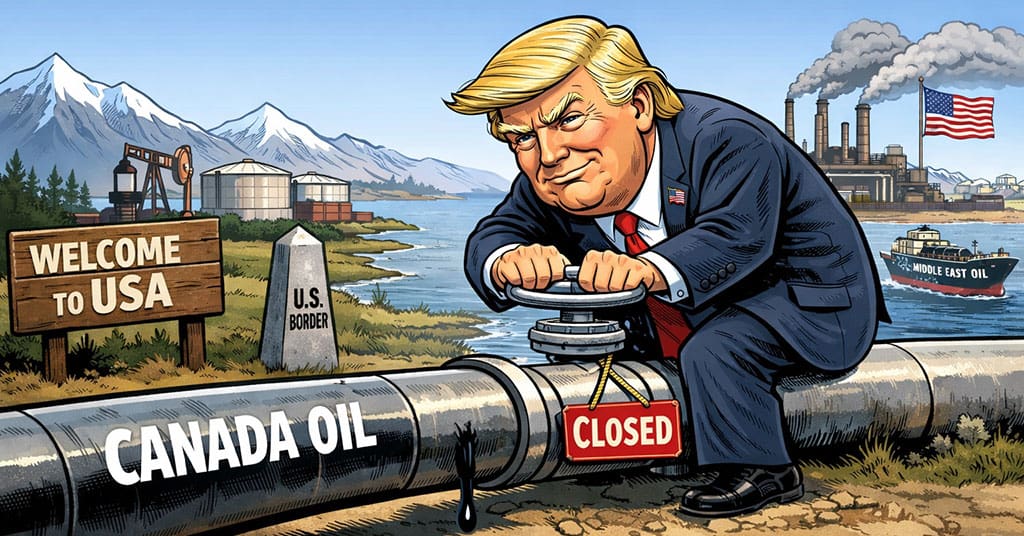
For years, Canada relied on the U.S. to take its oil. Now that bet is coming back to haunt us
It has been a turbulent week for oil markets, with geopolitics, not fundamentals, driving crude prices and exposing Canada’s dangerous dependence on the United States.
This dependence is not theoretical. About 95 per cent of Canada’s crude oil exports, more than four million barrels per day, go to the U.S. It is a failure that has left Canada vulnerable at precisely the moment oil has become an overt geopolitical weapon.
The Ottawa–Washington tiff is only one of several pressures now bearing down on oil markets. The U.S. is openly using economic coercion through tariffs to pressure allies and adversaries alike, reshaping the global order in its favour and signalling that energy security will be dictated by power, not partnership.
U.S. President Donald Trump’s anger toward Prime Minister Mark Carney reflects this shift. Carney’s assertion at Davos that the old world order is gone and that middle powers such as Canada must chart an independent, principled course has been met not with debate but with threats. That response clarifies the stakes for Ottawa.
Trump has threatened 100 per cent tariffs on Canadian goods in an apparent effort to derail improving ties between Beijing and Ottawa. Those threats appear to extend even to exports of heavy, sour Canadian crude to the U.S. This matters because heavy, sour oil can only be processed by a limited number of specialized refineries, many of them located on the U.S. Gulf Coast. Canada cannot simply redirect those barrels overnight.
With the capture of Venezuelan President Nicolás Maduro on Jan. 3 and subsequent U.S. moves to ease sanctions and allow greater access to Venezuelan oil, Trump has created the possibility of an alternative source of supply. Venezuelan crude, like Canadian oil, is heavy and sour, making it a potential substitute for some Canadian oil in U.S. refineries. That possibility by itself weakens Canada’s leverage when alternatives are available.
Canada is now scrambling to find new markets for its oil, but market access means little without physical access. Ottawa still lacks sufficient routes to move crude from Alberta to ports in B.C. and beyond for shipment to Asia and other destinations. Pipeline projects have been delayed or blocked through regulatory hurdles, court challenges and provincial and Indigenous opposition, even though interprovincial trade is constitutionally a federal responsibility.
If 100 per cent tariffs are imposed, some Canadian crude currently flowing south could be stranded almost immediately. That level of dependence is indefensible. It is a strategic liability created by delay and denial. Developing alternative markets and the infrastructure to reach them is urgent.
This Canadian vulnerability is unfolding even as global oil markets are being shaken by aggressive state action elsewhere.
Last week, Trump intensified pressure on Iran, imposing additional sanctions on vessels transporting its oil and announcing that an armada was heading to the region. Warships, including an aircraft carrier and guided-missile destroyers, are expected to arrive in the Middle East in the coming days, Reuters reported, citing a U.S. official.
Washington followed by sanctioning nine vessels and eight firms involved in transporting Iranian oil and petroleum products, according to the U.S. Treasury. These measures are aimed directly at constraining supply.
Supply risks also emerged in Central Asia. Kazakhstan’s Tengiz oilfield, shut down after a fire last Monday, may remain offline for the rest of the month. The field accounts for nearly half of Kazakhstan’s output. Production is expected to average one million to 1.1 million barrels per day, well below the country’s usual level of about 1.8 million.
At the same time, regime change has become an increasingly normalized tool of policy. In this “New World Order,” reports indicate the Trump administration is weighing new tactics to force political change in Cuba, including a total blockade of oil imports. That pressure is now extending beyond Havana. Senior officials appear openly supportive of deposing leaders in Latin America whom they view as adversaries.
Cuba is already suffering. The loss of Venezuelan oil shipments following Maduro’s departure, and the resale of cargoes Havana relied on for foreign currency, has throttled its economy.
Mexico, the single-largest remaining oil supplier to Cuba, is also reportedly considering whether to scale back or suspend oil exports to Cuba amid concerns inside President Claudia Sheinbaum’s government that continuing the policy could provoke U.S. retaliation.
Against this backdrop, West Texas Intermediate (WTI) and Brent crude both posted weekly gains of more than 2.5 per cent. Markets are responding to heightened supply risk created by sanctions, outages and political intervention, not rising demand.
Oil is no longer merely a commodity. It is leverage. And in a world where energy is wielded openly as a geopolitical tool, Canada’s failure to secure independent market access is not just shortsighted. It is dangerous.
Toronto-based Rashid Husain Syed is a highly regarded analyst specializing in energy and politics, particularly in the Middle East. In addition to his contributions to local and international newspapers, Rashid frequently lends his expertise as a speaker at global conferences. Organizations such as the Department of Energy in Washington and the International Energy Agency in Paris have sought his insights on global energy matters.
Explore more on Energy sector, Trade, Canadian economy, Pipelines, Canada-US relations, Energy security
The views, opinions, and positions expressed by our columnists and contributors are solely their own and do not necessarily reflect those of our publication.
Troy Media empowers Canadian community news outlets by providing independent, insightful analysis and commentary. Our mission is to support local media in helping Canadians stay informed and engaged by delivering reliable content that strengthens community connections and deepens understanding across the country.

