
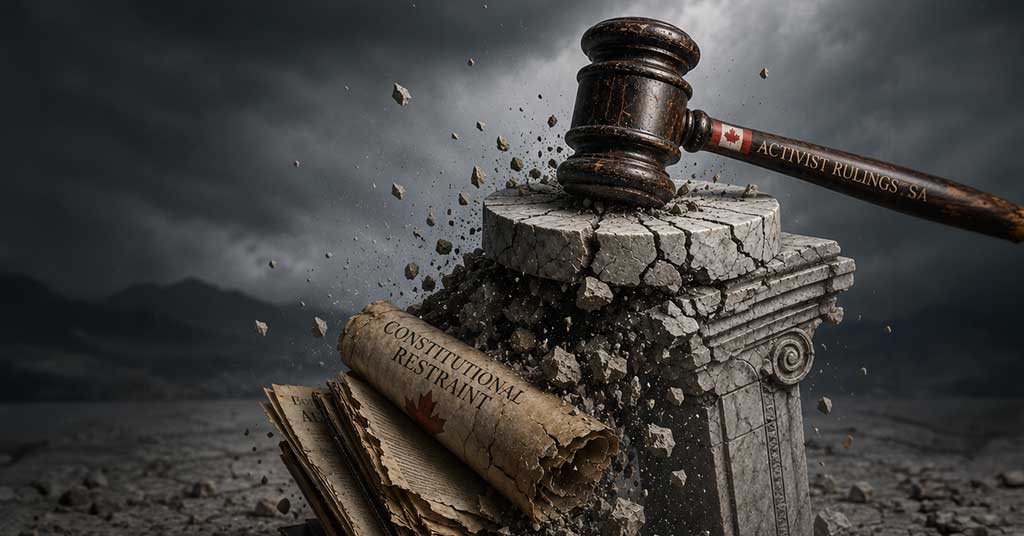
Our courts have traded their role as impartial arbiters for an ideological agenda, and our democracy is paying the price
When the chief justice of the Supreme Court refuses to recuse himself from a case involving litigants he has already publicly condemned, the facade of judicial neutrality finally crumbles. Richard Wagner’s refusal to step aside from the Emergencies Act appeal is not just a procedural error; it is the latest symptom of a judiciary that has traded legal neutrality for political activism.
Wagner publicly characterized participants and supporters of the 2022 trucker convoy in terms that some litigants found condemnatory. He has now refused to recuse himself from the upcoming appeal, despite being requested to do so by the litigants. In any other courtroom, a potential juror would be dismissed for such clear bias. His refusal now taints any decision his court will make and, in my view, diminishes the standing of the court he purports to lead.
But Wagner’s conduct is merely the latest example of a deeper problem. Canada’s courts increasingly see themselves not as neutral arbiters, but as engines of social change.
During the COVID-19 pandemic, we saw this in real-time. As governments imposed extreme and often irrational measures—prohibiting public worship while allowing air travel, or restricting the movement of pets—Canadian courts almost without exception refused to exercise their constitutional role as a check on executive power.
This is not an isolated phenomenon. We are witnessing a fundamental shift in the judicial culture, where the same progressive worldview that allowed the courts to ignore government overreach during the pandemic is now being applied to rewrite our foundational property and citizenship laws under the banner of “reconciliation.”
We see this clearly in the courts’ handling of Indigenous claims and property rights.
The Cowichan case is a prime example, where a judge decided that basic home ownership should be sacrificed to the demands of “reconciliation.” In my view, such a decision is legally and fundamentally wrong. Under the B.C. government’s current interpretation of the Declaration on the Rights of Indigenous Peoples Act (DRIPA), the province is increasingly moving toward “consent-based” decision-making, which many property owners fear will grant unelected band councils a veto or direct oversight role over provincial land-use and natural resource management. By recklessly throwing the certainty of title into doubt, the courts have undermined the foundation of a functioning democracy.
The judiciary’s trajectory on Indigenous issues can be traced back to the 1990 R. v. Sparrow decision. That ruling, which established the “honour of the Crown” and the framework for justifying infringements on Aboriginal rights, is widely viewed by legal scholars as the moment the Supreme Court shifted from interpreting Section 35 as a recognition of existing rights to an active architect of a new, post-colonial constitutional order. The Court moved to disregard the clear mandate of Section 35, effectively usurping parliamentary supremacy. In subsequent cases like Delgamuukw and Tsilhqot’in, the courts threw out normal evidentiary rules, accepting hearsay as “oral history” and allowing claims made centuries after the fact.
Essentially, the rules were discarded to ensure these claims succeeded. The Supreme Court departed from its proper role, becoming an advocate for Indigenous causes rather than an interpreter of the law. This has been compounded by government litigation directives that force Crown lawyers to negotiate with one hand tied behind their backs to avoid offending Indigenous sensibilities. Extinguishment—the legal principle that certain Aboriginal rights can be settled or “extinguished” through treaty and replaced with clearly defined rights—was once a standard tool for achieving legal certainty in land claims, but it has been effectively abandoned by the Crown under recent litigation directives.
I believe our courts have taken us down a dark rabbit hole. The quest for “reconciliation” is being used to pursue demands that cannot be achieved without fatally weakening the country. We are seeing a B.C. “co-governance” plan that is, in my view, a dangerous overreach of executive and judicial power—an attempt to grant unelected bands control over the lands of millions of residents.
If this continues, the results will be decades of uncertainty, litigation for the benefit of chiefs and lawyers, and the erosion of equal citizenship. We are drifting toward a weak, apartheid-style federation of race-based states.
The growing distrust of Canada’s courts is no longer about a single ruling or one protest. Canadians are recognizing that the judiciary has abandoned neutrality and constitutional restraint. We must find a way to restore Canada to what it was meant to be—a country of equals—before the destabilizing consequences of this judicial activism prove unconstitutional and undermine the nation itself.
Brian Giesbrecht is a retired judge and a senior fellow at the Frontier Centre for Public Policy.
Explore more on Law, Aboriginal land claims, Coercive progressivism, Property rights, Democracy
The views, opinions, and positions expressed by our columnists and contributors are solely their own and do not necessarily reflect those of our publication.
Troy Media empowers Canadian community news outlets by providing independent, insightful analysis and commentary. Our mission is to support local media in helping Canadians stay informed and engaged by delivering reliable content that strengthens community connections and deepens understanding across the country.

