
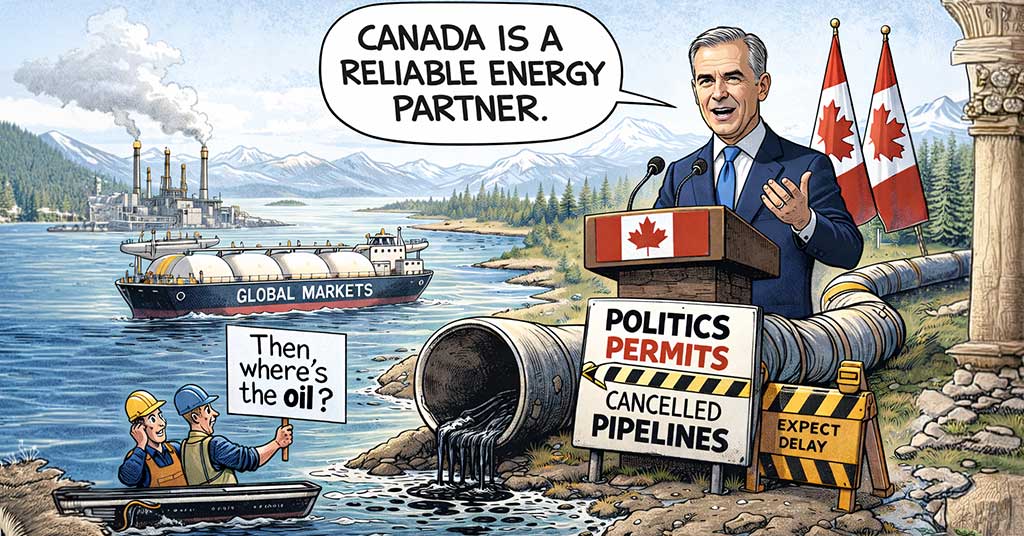
The world knows otherwise. Canada has the oil but years of political obstruction keep it from reaching markets

The world is scrambling for reliable oil suppliers as one of the largest supply disruptions in the history of oil hits global energy markets.
In early March, Israel and the United States launched coordinated strikes against Iran, triggering a regional conflict that quickly spilled into global markets.
Iran retaliated by disrupting shipping through the Strait of Hormuz. The narrow waterway normally carries roughly 20 per cent of the world’s oil supply, making it one of the most important oil routes on the planet.
The impact was immediate. Tanker traffic slowed sharply, oil prices surged toward US$100 a barrel and governments began releasing emergency reserves.
In moments like this, the world looks for producers that can quickly supply additional oil to global markets. Canada is not one of them.
During a meeting with Norwegian Prime Minister Jonas Gahr Støre in Oslo on March 14, Prime Minister Mark Carney presented Canada as a stable oil exporter and partner to the world. “From Canada’s perspective, we are low-risk producers of oil. We are low-risk producers of natural gas. We’re reliable,” he said.
Stable we may be. Reliable we are not. When Germany and Asian partners asked Canada to supply more oil and natural gas during earlier energy shortages, they were effectively told by then-prime minister Justin Trudeau that there was no business case for expanding exports. Germany instead secured energy supplies from Qatar and the United States.
Canada’s export infrastructure tells the same story. Major projects such as the proposed Energy East pipeline, which would have carried western oil to Atlantic export terminals, were abandoned after years of regulatory uncertainty, rising costs and political opposition that made the project commercially unviable.
Canada is one of the world’s largest oil producers. But most of its crude flows south to the United States because export infrastructure to global markets was never built. Canada’s oil pipelines are largely oriented north-south into the U.S. refining system rather than to overseas export terminals. That was a political choice.
In the short term (one to two years), Canada cannot do much to ease the current supply shock. Oil production is already running near capacity and most Canadian crude flows to the U.S. through existing pipeline systems. Without additional export infrastructure, there is little ability to redirect large volumes to global markets during a crisis. The reality is that our oil cannot reach global markets quickly enough to matter.
In the mid-term (three to five years), Canada could modestly expand its role. Oil sands production in northern Alberta continues to grow and the Trans Mountain pipeline expansion now allows more Canadian oil to reach the Pacific coast for export to overseas markets. But these changes add supply gradually rather than quickly. They will not solve today’s crisis.
In the long term (10 years or more), the potential is far larger if the political will is there. Canada holds the world’s third-largest proven oil reserves and operates one of the most politically stable energy sectors in the world. With additional pipelines, export terminals and liquefied natural gas infrastructure, Canada could become one of the most reliable energy suppliers in global markets.
For now, however, Canada’s ability to respond remains limited. Canada produced on average 5.3 million bpd of crude oil in 2025, according to the Canada Energy Regulator. And as part of the International Energy Agency’s plan to increase oil supply, Canadian production is set to increase by about 140,000 barrels per day starting in April, according to the Natural Resources minister’s office.
That increase represents about a 2.6 per cent rise in Canadian supply. It also illustrates the broader constraint. Canada can grow production. It just cannot deliver it when the world needs it.
Canada has the resources to be a global energy leader. What it lacks is the infrastructure and the political will needed to become one.
Toronto-based Rashid Husain Syed is a highly regarded analyst specializing in energy and politics, particularly in the Middle East. In addition to his contributions to local and international newspapers, Rashid frequently lends his expertise as a speaker at global conferences. Organizations such as the Department of Energy in Washington and the International Energy Agency in Paris have sought his insights on global energy matters.
Explore more on Energy sector, Pipelines, World economy, Energy security
The views, opinions, and positions expressed by our columnists and contributors are solely their own and do not necessarily reflect those of our publication.
Troy Media empowers Canadian community news outlets by providing independent, insightful analysis and commentary. Our mission is to support local media in helping Canadians stay informed and engaged by delivering reliable content that strengthens community connections and deepens understanding across the country.

